
Design is the silent salesperson of your digital product. Every pixel, every interaction, every micro-animation either moves users toward conversion or pushes them away. In our work with over 150 brands, we have consistently found that strategic design improvements deliver the highest ROI of any digital investment.
This guide distills our proven methodology for creating interfaces that are beautiful, intuitive, and ruthlessly optimized for conversion.
Start With Research, Not Pixels
The most expensive design mistake is building the wrong thing beautifully. Before opening Figma, we invest significant time understanding the target audience through user interviews, competitive analysis, analytics review, and jobs-to-be-done framework mapping.
User interviews reveal motivations and pain points that analytics cannot. We conduct a minimum of five moderated interviews for every major project, synthesizing findings into user personas that guide every subsequent design decision.
Information Architecture and User Flows
Once we understand the user, we map out the information architecture and critical user flows. Every page should have a single primary objective. If you cannot articulate what success looks like for a specific page, that page needs rethinking.
We use card sorting exercises with real users to validate our navigation structure. This simple technique consistently reveals organizational assumptions that do not match how users actually think about content and features.
Wireframing With Purpose
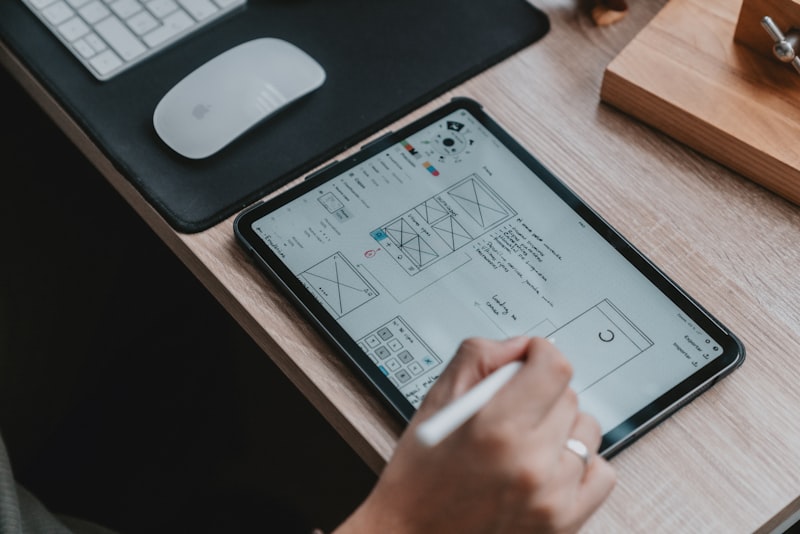
Our wireframing process moves through three fidelity stages. Low-fidelity sketches on paper or whiteboard explore many concepts rapidly. Medium-fidelity digital wireframes establish layout, hierarchy, and content structure. High-fidelity prototypes in Figma add visual design, real content, and interactive behaviors.
Each stage includes stakeholder review and, ideally, user testing. Catching navigation issues in a paper prototype costs hours. Catching them after development costs weeks.
Design Systems for Consistency and Speed
Every client project at Jafen Media includes a design system: a library of reusable components, typography scales, color tokens, spacing values, and interaction patterns. This investment pays dividends immediately through faster design iterations and consistent implementation.
Our design systems use atomic design principles, building from foundational tokens up through atoms, molecules, organisms, and templates. This hierarchical approach ensures that changes propagate consistently and that new pages can be assembled from existing, tested components.
Conversion-Focused Visual Hierarchy
The most impactful conversion technique is proper visual hierarchy. Users should immediately understand what to look at first, what action to take, and why it matters to them. We achieve this through strategic use of size contrast, color emphasis, whitespace, and directional cues.
A study by the Nielsen Norman Group found that users read web pages in an F-pattern. We design with this behavior in mind, placing the most critical information and calls-to-action where eyes naturally land.
Micro-Interactions That Delight
Thoughtful micro-interactions transform a functional interface into an experience that feels alive. Button hover states, loading animations, success confirmations, and scroll-triggered reveals all contribute to perceived quality and user confidence.
However, restraint is essential. Every animation should serve a purpose: providing feedback, guiding attention, or creating spatial context. Gratuitous animation fatigues users and hurts performance.
Measuring Design Success
Design without measurement is decoration. We establish baseline metrics before any redesign and track conversion rates, task completion rates, time-on-task, error rates, and user satisfaction scores throughout the process. This data-driven approach ensures that design decisions produce measurable business outcomes.
Frequently Asked Questions
Quick answers to common questions
UI (User Interface) design focuses on the visual elements users interact with, such as buttons, typography, and color schemes. UX (User Experience) design is the broader process of researching user needs, mapping user journeys, and ensuring the overall product is intuitive and satisfying to use.
Good UI/UX design reduces friction in the user journey by making navigation intuitive, calls-to-action clear, and forms simple to complete. Studies show that every dollar invested in UX returns up to $100 in increased conversions, lower bounce rates, and higher customer retention.
The most popular UI/UX design tools in 2025 include Figma for collaborative interface design, FigJam for brainstorming and wireframing, and Maze or Hotjar for usability testing. Many teams also use design systems built in Storybook to maintain consistency across products.
A typical UI/UX design project takes between 4 and 12 weeks depending on scope. This includes user research (1-2 weeks), wireframing and prototyping (2-4 weeks), visual design (2-3 weeks), and usability testing with iterations (1-3 weeks).
Ready to Build Something Great?
Let's discuss how we can help you achieve your digital goals with a free consultation.